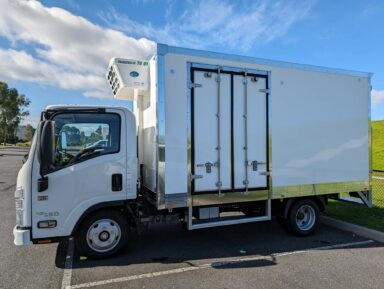
Best Refrigerated Van Layouts for Delivery Businesses
November 20, 2026

Two vans can leave the workshop with the same refrigeration unit and perform very differently on the road. The reason usually sits behind the doors. Where the shelves go, how the cargo area is divided, and which door your driver opens dozens of times a day all shape how well a refrigerated van works for your business.
The best layout is built around what you carry, how many stops you make, and how goods come out at each drop. Here’s how to work that out before the fit-out begins.
Key Points
- Layout affects delivery speed, temperature stability, loading time, and product damage.
- Every fitting uses space and payload, so each one should solve a real problem.
- Shelving, partitions and door access are the three decisions that matter most.
- Food, pharmaceutical, floral and courier operators each need a different setup.
Why Does Layout Matter in a Refrigerated Van?
A van’s layout controls how quickly drivers find stock, how much cold escapes at each stop, and how well the load survives braking and corners. Get it right, and the unit spends less time recovering after every door opening.
There’s a catch. Racking, partitions, and heavy floors add weight and take up room, which eats into payload on smaller vans. Good van refrigeration units do the cooling, but the layout decides how much of that work actually reaches your product.
The Three Layout Decisions That Matter Most
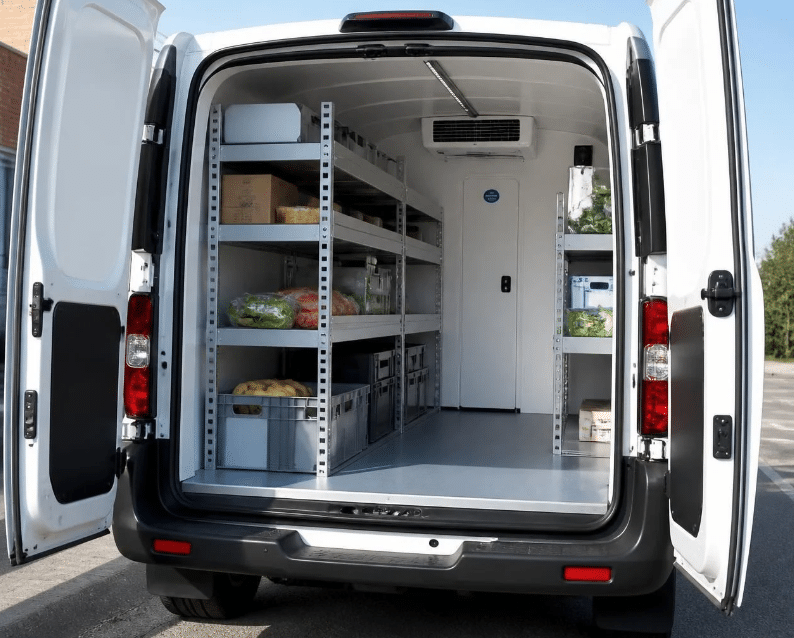
Shelving, racking and load restraint
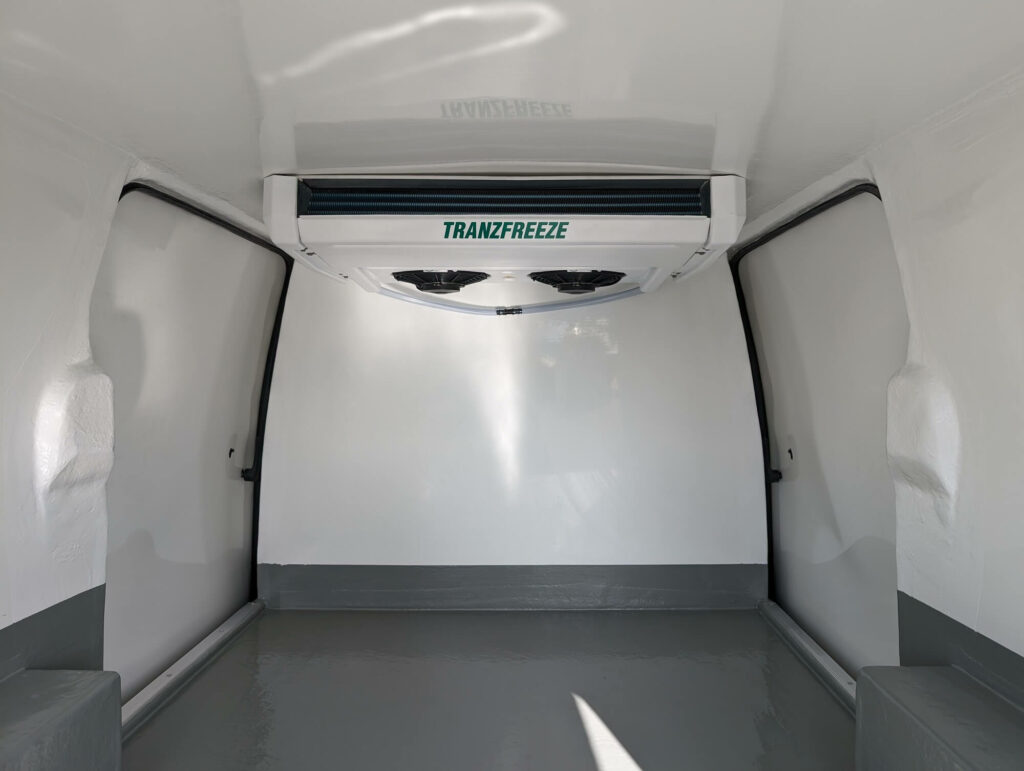
Custom racking keeps crates off the floor and stock in a set place, which speeds up every drop. Kick panels (from 400 mm to 1,200 mm high) protect the lower walls from trolleys and boots, while shoring bars stop loads sliding. Keep clear space in front of the evaporator. Shelves packed hard against it starve the rest of the van of cold air.
Partitions and bulkheads
A divider wall splits the cargo area into two zones, so chilled and frozen stock can travel together. A vapour barrier bulkhead between the cab and the load stops cold air leaking forward and keeps the driver comfortable. A Perspex window version lets drivers see the load from the cab.
Rear doors, side doors, or both?
Rear doors suit bulk deliveries, trolleys and full-load drops. A side door lets drivers grab a single order without opening up the whole back, which helps on busy multi-stop runs. Many operators use both and fit curtains to limit temperature loss. You’ll find each of these fittings in our range of optional extras.
Which Refrigerated Van Layout Suits Your Business?
Food distribution and catering
- ✓ Wall-to-wall checker plate (bonded or welded) for daily wash-downs
- ✓ Custom racking built to the exact size of your crates or trays
- ✓ Dual-temp divider wall if chilled and frozen stock share one trip
Pharmaceutical deliveries
Under the National Vaccine Storage Guidelines, vaccines need to stay between +2 °C and +8 °C. Layout helps hold that range.
- ✓ Secure shelving so cartons don’t shift or block airflow
- ✓ One stable zone rather than a split cargo area
- ✓ A planned spot for the monitoring probe, away from the doors
Florists
- ✓ Florist floor to hold buckets upright
- ✓ Drain holes so spilt water doesn’t pool
- ✓ Open floor space instead of fixed shelving
- ✓ Buckets placed out of the direct path of the evaporator fan
Couriers and parcel runs
- ✓ Side access for single drops
- ✓ Shelving arranged to match your delivery order
- ✓ Strip curtains on any door that opens often
- ✓ LED lighting so drivers can read labels at the back before sunrise
Questions to Answer Before Your Fit-Out
Bring these answers to your quote:
- How many drops does the van make each day?
- Which door will the driver use most?
- Is stock moved in crates, cartons, buckets, or on trolleys?
- Does the cargo area need washing down?
- Do you need one temperature zone or two?
At Tranzfreeze, we’ve been building refrigerated vans in Melbourne for more than 35 years, from large fleet vans to a seven-seat Caddy that had two seats removed to make room. Our Dandenong South team can help you plan a layout that suits the way you deliver.
Frequently Asked Questions
1. Can a refrigerated van layout be changed after it’s built?
Some parts can. Shelving, shoring bars and curtains are often added or moved later. Floors, divider walls and bulkheads are far easier to get right during the original build.
2. Does shelving affect cooling in a refrigerated van?
Yes. Shelves placed against the evaporator or loaded to the roof restrict air movement and create warm spots. A good design leaves a gap around the unit so air can travel across every level.
3. Is a side door worth having on a refrigerated van?
For multi-drop work, usually yes. Drivers can reach individual orders without opening the rear doors, so less cold is lost at each stop.
4. What does a bulkhead do in a refrigerated van?
A bulkhead separates the cargo area from the cab. It stops cold air drifting forward, reduces the space the unit has to cool and keeps the driver’s area comfortable.
5. How long does a refrigerated van fit-out take?
A standard fit-out usually takes around one to two weeks from measure-up to handover. The van model, unit and extras such as a florist floor all affect timing, and multi-temp builds take a little longer.