How to Choose the Right Refrigerated Truck Body for Your Business
March 22, 2026

Choosing the wrong refrigerated truck body can create problems from day one. You might end up with a body that is too large for your daily load, not cold enough for the product you carry, hard to clean, or awkward to load on a busy delivery run. For businesses moving food, flowers, chemicals, medical goods, or live animals, the right body starts with the job it needs to do every day.
At Tranzfreeze, that is how we approach every truck refrigeration project. We have been manufacturing transport refrigeration equipment in Australia since 1989, and we build refrigerated truck bodies for a wide mix of commercial applications in Melbourne, Victoria, and across Australia.
Key points
- The right refrigerated truck body depends on product type, target temperature, load size, and delivery pattern.
- Tranzfreeze builds bodies from a single-pallet ute body up to a rigid 14-pallet truck, with setups for about -25°C to +18°C applications.
- Below-zero bodies need different panel construction from chiller bodies, so insulation choice matters.
- Flooring, access doors, tie-downs, lighting, and standby power should be planned before the build starts.
- Better build quality can save money over the life of the vehicle.
What is a refrigerated truck body?
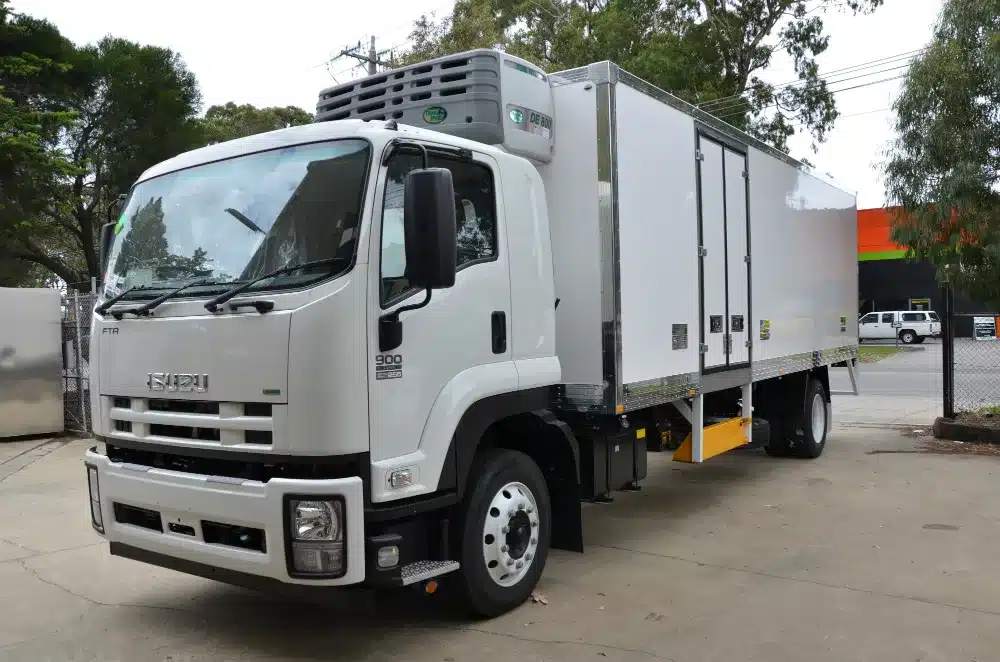
A refrigerated truck body is an insulated cargo body matched with a refrigeration unit to keep goods within a required temperature range while they are being transported. Our truck units suit different body sizes and temperatures, and our truck refrigeration page outlines options for customised truck bodies, electric standby, and different operating ranges.
In practical terms, we build bodies from small single-pallet ute setups through to rigid trucks up to 14 pallets. Common body sizes are often described by pallet capacity, such as 3-pallet, 6-pallet, 8-pallet, 12-pallet, and 14-pallet bodies. That matters because buyers usually think in terms of what they load, not just body length and width.
Which businesses need a refrigerated truck body?
Refrigerated truck bodies are widely used in food transport, food service, catering, wholesale supply, butchery, floristry, and primary production. They are also used in chemical transport, pharmaceutical distribution, medical samples and devices, and animal transport, where temperature control protects the product or animal during transit.
For food operators, Food Standards Australia New Zealand says potentially hazardous food should be transported at 5°C or colder, and the Victorian Government’s food safety guidance says frozen food should stay frozen solid during transport. In pharmaceutical work, the TGA’s good wholesaling practice guidance notes that cold chain medicines commonly sit in the 2°C to 8°C range and need an unbroken temperature-controlled supply chain.
Key things to check before you choose a truck body
This is where the best buying decisions are made. Sean’s advice is to start with the load, then work back to the body.
First, ask what temperature the product needs to be maintained at. Fresh fish, frozen meat, chilled dairy, flowers, and medical stock all have different transport needs. Some businesses only need one stable temperature. Others carry mixed loads and need a freezer zone in the front and a fridge zone in the back.
Next, work out how much space you really need. That means pallet count, crate size, carton volume, and payload, not just body dimensions. A 3-pallet body and a 6-pallet body can suit very different operations, even if the vehicle footprint looks similar. Oversizing the body can mean more weight, more fuel use, and a truck that is less practical on metro runs.
You also need to think about how the load is handled. Is the product palletised, hand-loaded, stacked in crates, or hung on rails? Will the body be washed down often? Do you need one side door, two side doors, or rear-only access? These details shape the floor, wall protection, drainage, and internal layout.
Standby power is another key question. If the product needs to stay at a temperature overnight with the engine off, you may need an electric standby. For some applications, that means 240V, while others may need 415V three-phase standby, depending on the site and operating pattern.
Materials and features that matter
Not all refrigerated truck bodies use the same panel construction, and that matters more as temperatures drop.
For below‑zero applications, particularly on larger bodies, construction is designed to deliver higher insulation performance and greater structural durability. This approach is better suited to freezer operations, where the body must withstand more demanding operating conditions over time.
For chiller applications around 0 °C and above, the construction requirements are less extreme. These bodies can be built with insulation and structural characteristics suited to chilled transport, where the same level of freezer‑grade performance is not required.
Then there is the fit-out. Our optional extras include checker plate, flat floors, pallet skates, pallet strips, shoring bars, dividers, kick panels, curtains, electric standby, and door seals. Sean’s examples also point to other practical options such as smooth fibreglass floors for wash-down work, meat hangers, drain pipes, extra LED lighting, tie-down points, internal wall protection, extra doors, and multi-compartment layouts. The main point is simple: there is no standard body that suits every business.
Why build quality matters
A refrigerated truck body works hard, so build quality shows up in daily use. Precise manufacturing helps with panel fit, door sealing, and temperature stability. Sean’s notes point to several details that matter here, CAD-designed bodies, CNC-cut fibreglass panels, CNC-cut and folded stainless steel door frames, hard-wearing black rubber seals, and strong subframes that can sometimes outlast the original chassis.
That kind of accuracy also helps later. Replacement doors can be reproduced from the serial number, which can reduce headaches if a vehicle is damaged and needs repair. We also back our builds with installation, servicing, repairs, and spare parts support, which is a major part of value once the vehicle is on the road.

Choosing the right truck body for business use
The best refrigerated truck body is the one that matches your product, route, loading method, and operating routine. It should hold the right temperature, carry the right load, and make the job easier for your team.
We are a strong choice because we combine Australian-made manufacturing, custom truck body design, a broad range of truck refrigeration options, and practical fit-out extras for real transport work. If you are weighing up a new refrigerated truck body, the best next step is to map out your product type, target temperature, pallet count, payload, standby power needs, and loading method before you request a quote.
FAQs
1. What size refrigerated truck body does my business need?
Start with your daily load, pallet count, crate size, and payload, then match the body to that job. We build from small ute bodies through to large rigid truck bodies, so the right size depends on how you actually operate, not just what might fit on paper.
2. Do I need a single-temperature or dual-temperature truck body?
If you only carry one product type at one target temperature, a single-zone body may be enough. If you move mixed loads, such as frozen stock and chilled stock on the same run, a dual-zone or multi-compartment body can give you more flexibility.
3. What flooring is best in a refrigerated truck body?
That depends on how you load and clean the vehicle. Checker plate, flat floors, pallet skates, pallet strips, and other fit-out options each suit different uses, so the best floor is the one that matches your freight and handling method.
4. Do I need an electric standby?
An electric standby is useful when the body needs to hold temperature with the engine off, such as overnight storage or early loading before a run. We list electric standby as an available option, and it can be a smart addition when protecting stock outside driving hours matters.
5. Why does build quality matter so much?
Better build quality supports tighter door seals, steadier temperatures, and a body that keeps working over the life of the vehicle. That is why body construction, panel choice, frame strength, and after-sales support all matter just as much as the refrigeration unit itself. When we specify a body, we are looking at the full job, not just the box and not just the unit.